

Is Your Business Data Ending Up in ChatGPT?
Employees are using AI tools like ChatGPT to work faster, write better, and solve problems—but they may also be sharing sensitive business information without realizing the risk. Shadow AI is becoming a growing cybersecurity and data governance concern for organizations of every size. The key isn’t banning AI. It’s making sure your team knows how to use it safely.
Artificial intelligence has moved into the workplace incredibly quickly.
Employees are using tools like ChatGPT and other AI assistants to write emails, summarize documents, analyze information, troubleshoot problems, prepare reports, create proposals, and speed up everyday tasks.
In many cases, that is a good thing. AI can save time and make employees more productive.
But there is an important question every business should be asking:
What information is your team putting into these AI tools?
Welcome to the world of Shadow AI.
What Is Shadow AI?
Shadow AI is the use of artificial intelligence tools within an organization without the knowledge, approval, or oversight of the IT department or management.
It is similar to the older problem of “Shadow IT,” where employees might sign up for their own cloud storage, messaging app, or online service because it makes their job easier.
Today, the same thing is happening with AI.
An employee discovers that ChatGPT can summarize a long document in seconds. Another uses an AI assistant to improve a customer proposal. Someone else pastes an error message into an AI tool to troubleshoot a technical problem.
Individually, these actions may seem harmless.
The problem is that employees may also be copying and pasting company information into systems that the organization has never reviewed or approved.
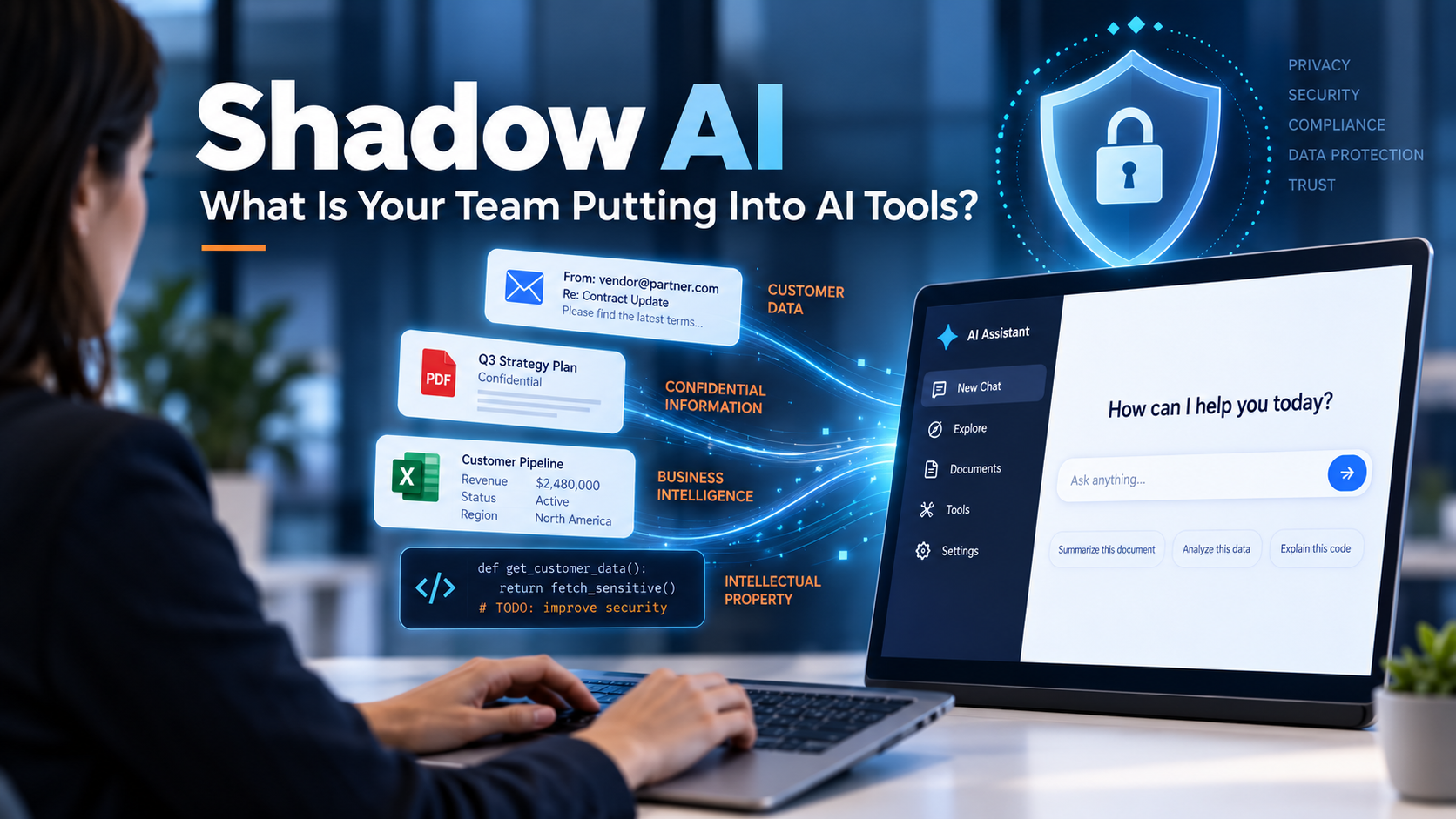
What Are Employees Sharing?
Consider what someone might paste into an AI assistant during a normal workday:
- Customer information
- Internal emails
- Contracts
- Financial reports
- Meeting notes
- Employee information
- Sales data
- Business strategies
- Proprietary procedures
- Software code
- Network configurations
- Password-reset information
- Confidential documents
Most employees are not intentionally creating a security problem.
They are simply trying to get their work done faster.
That is what makes Shadow AI particularly challenging. It often starts with perfectly reasonable intentions.
The Copy-and-Paste Problem
AI has made copying and pasting information incredibly convenient.
Need an email rewritten? Paste it into ChatGPT.
Need a contract summarized? Upload it.
Need help fixing some code? Paste the code.
Need a spreadsheet analyzed? Upload the spreadsheet.
But before information leaves your organization’s systems, someone needs to ask an important question:
Should this information be shared with an external AI service at all?
Different AI platforms, accounts, subscriptions, and enterprise products can have different privacy, retention, security, and data-handling arrangements.
Your employees probably haven’t reviewed those details before clicking Send.
Your IT team should.
Blocking AI Isn’t the Answer
For most organizations, attempting to completely ban AI is unlikely to be a practical long-term strategy.
Employees are already discovering how useful these tools can be.
A blanket ban can simply push AI use underground, making Shadow AI even more difficult to identify.
A better approach is to establish clear guidelines around which AI tools employees may use and what information may be shared with them.
Businesses have dealt with similar transitions before.
Cloud computing, smartphones, remote work, online file sharing, and collaboration platforms all created new security questions. Organizations eventually developed policies and technology standards that allowed people to benefit from those tools while protecting business information.
AI should be approached in much the same way.
Start With a Simple AI Policy
Your AI policy does not need to be 40 pages long.
Employees need practical rules they can understand.
For example, your organization might establish guidelines such as:
Approved AI Tools
Identify which AI services employees are permitted to use for company business.
Confidential Information
Clearly explain what types of company, customer, employee, and financial information should never be entered into unapproved AI platforms.
Account Requirements
Determine whether employees should use company-managed accounts rather than personal AI accounts.
Document Uploads
Establish rules around uploading spreadsheets, PDFs, contracts, presentations, source code, and other company documents.
Human Review
Make it clear that AI-generated information should be reviewed before it is sent to customers, published, or used to make important business decisions.
The goal isn’t to create more bureaucracy.
It is to remove uncertainty.
Employees should know what they can safely do with AI.
Give Employees a Safe Alternative
One of the biggest reasons Shadow IT exists is convenience.
If the approved company solution is difficult to use while an unapproved tool is easy, employees will often choose the easier option.
The same applies to AI.
Organizations should evaluate business-grade AI solutions and determine whether appropriate security, administrative controls, identity management, and data protections are available.
Once an approved platform is selected, employees should be shown how to use it effectively.
Instead of telling employees:
“Don’t use AI.”
A better message is:
“Here’s how we use AI safely at our company.”
That small change can make a significant difference.
Training Matters
Cybersecurity awareness training has traditionally focused on threats such as phishing, passwords, malware, and suspicious attachments.
AI should now become part of that conversation.
Employees need to understand that entering information into an AI tool can potentially mean sharing information outside the company’s normal technology environment.
Training does not need to be complicated.
Teach employees to stop for a moment before submitting information and ask:
Would I be comfortable sending this information to an outside company?
If the answer is no—or they’re unsure—they should check with IT first.
AI Can Be Both Productive and Secure
AI is quickly becoming another everyday business tool.
Used properly, it can help employees write faster, research ideas, summarize information, automate repetitive tasks, and solve problems.
But organizations need visibility into how it is being used.
The biggest Shadow AI risk may not be the technology itself.
It may be not knowing that your employees are using it at all.
Now is a good time to talk with your team about the AI tools they already use, establish clear policies, identify approved solutions, and make sure your cybersecurity strategy reflects the way people actually work today.
Because the question is no longer whether your employees will use AI.
The question is what they are putting into it.