

Cyber Insurance Is Not a Cybersecurity Strategy
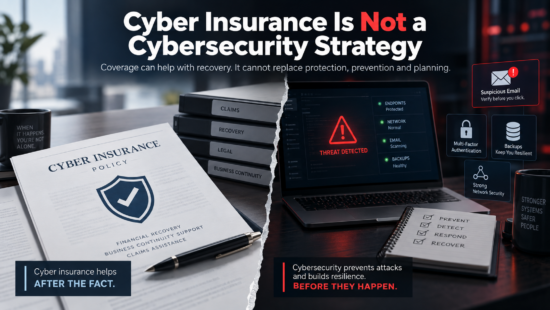
A cyber insurance policy can help an organization recover financially after an attack. It cannot stop an attacker from getting in, keep your systems running or guarantee that every loss will be covered.
For years, businesses have purchased insurance to manage risks they cannot completely eliminate.
Buildings are insured against fire. Vehicles are insured against accidents. Organizations carry liability insurance in case something goes wrong.
Cyber insurance follows the same basic idea.
If your organization suffers a ransomware attack, data breach, business email compromise or another serious cyber incident, a cyber insurance policy may help cover some of the financial consequences.
That can make cyber insurance an important part of an organization’s overall risk management strategy.
But there is one dangerous misunderstanding businesses need to avoid:
Buying cyber insurance is not the same thing as having a cybersecurity strategy.
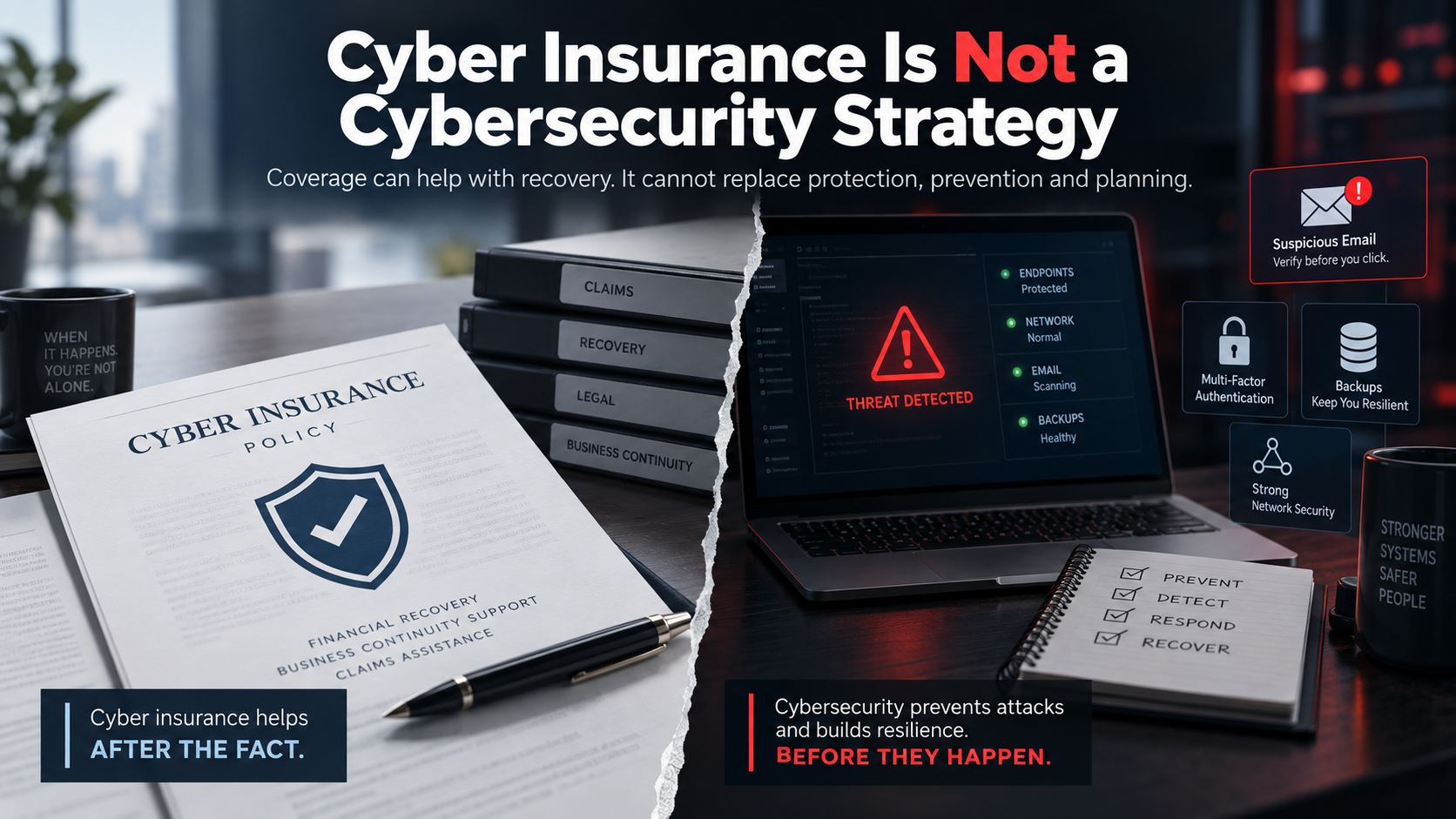
Insurance can help deal with some of the financial damage after an incident.
Cybersecurity is what you do to make the incident less likely to happen in the first place — and to reduce the damage when it does.
Insurance Does Not Stop the Attack
Imagine discovering Monday morning that ransomware has encrypted most of your network.
Employees cannot access files.
Your accounting system is offline.
Customer information is unavailable.
Email accounts may have been compromised.
Production or operations have stopped.
You call your insurance company.
Having coverage may prove extremely valuable at this point. Depending on the policy, cyber insurance can help pay for things such as forensic investigations, legal assistance, notification expenses, data recovery, business interruption, crisis communications and certain liabilities resulting from a breach.
But notice when the insurance policy becomes useful.
After something has already gone wrong.
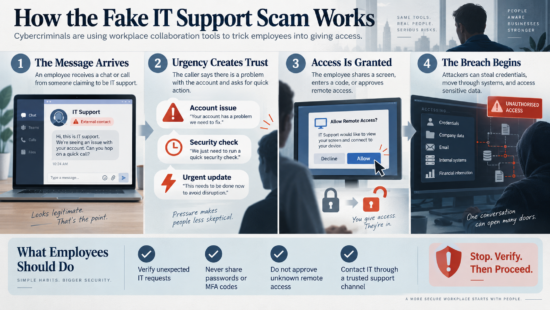
The insurance company was not sitting between the attacker and your Microsoft 365 account.
The policy did not install security updates.
It did not enable multifactor authentication.
It did not train an employee to recognize a phishing message.
It did not protect your backups.
Those responsibilities still belong to the organization.
Think of Cyber Insurance as Risk Transfer
One of the most useful ways to understand cyber insurance is to think about risk transfer.
An organization identifies risks that could create significant financial losses and purchases insurance to transfer some of that financial exposure to an insurer.
But transferring financial risk does not eliminate operational risk.
A manufacturer with cyber insurance could still lose production.
A medical office could still lose access to patient information.
A law firm could still lose access to documents.
A retailer could still be unable to process transactions.
A professional services firm could still spend days trying to determine which information was stolen.
Even if insurance eventually reimburses some of the expenses, the organization still experiences the disruption.
Customers still notice.
Employees still lose productivity.
Projects may still be delayed.
Revenue may still be interrupted.
And reputational damage cannot simply be restored from a backup.
Your Insurance Company Cares About Your Cybersecurity Too
There is another reason businesses should stop thinking of cyber insurance and cybersecurity as two separate subjects.
Insurance companies increasingly want to understand how you protect your organization before providing or renewing coverage.
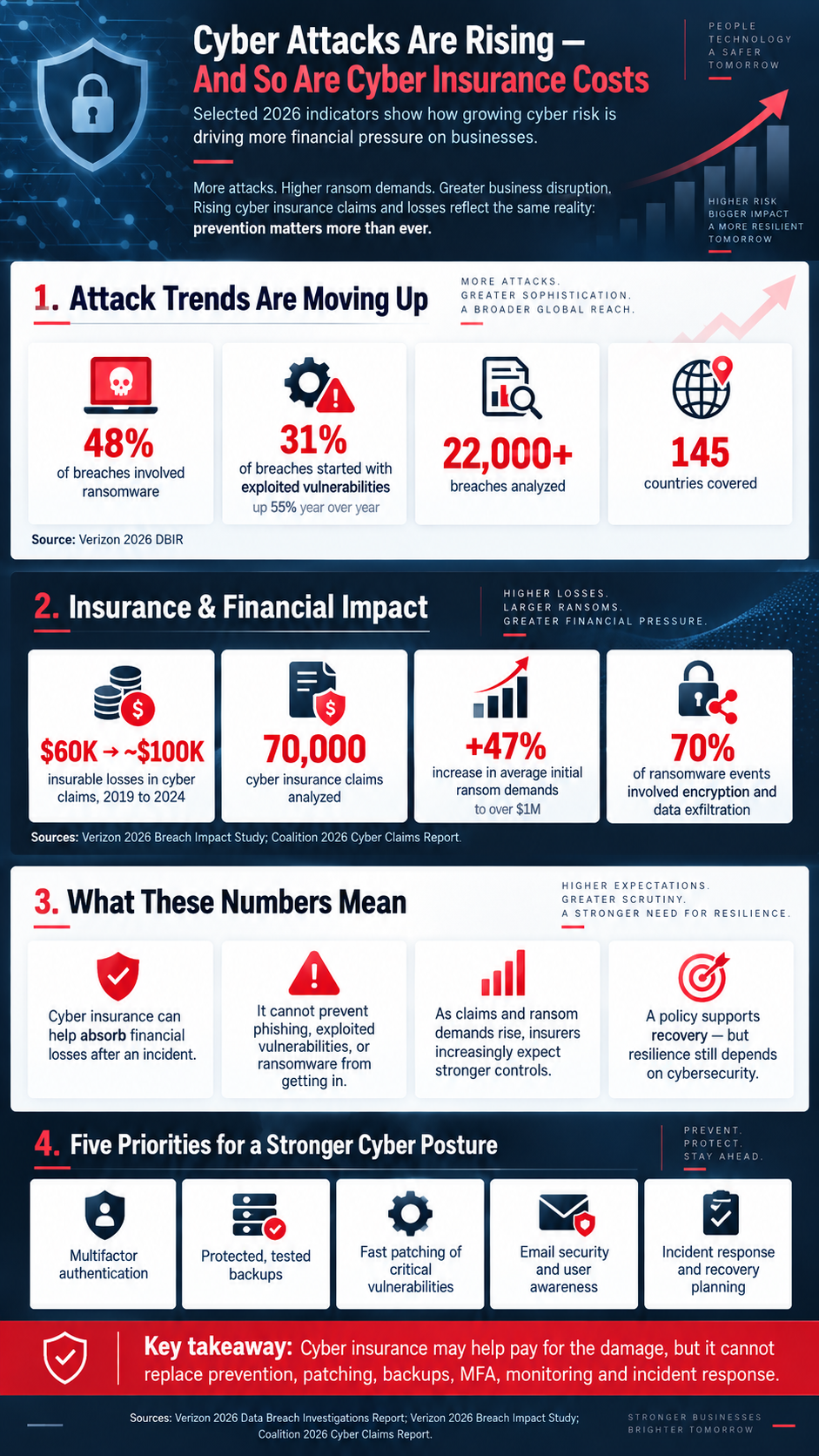
Cyber insurance applications may ask about controls such as:
- Multifactor authentication
- Backup procedures
- Endpoint security
- Security awareness training
- Privileged account protection
- Software patching
- Remote access
- Email security
- Identity and access management
- Incident response planning
In other words, insurers are not simply asking:
“How much coverage would you like?”
They also want to understand:
“How difficult have you made it for somebody to compromise your organization?”
The Answers on the Application Matter
This is an area businesses should take seriously.
If an insurance application asks whether multifactor authentication protects administrative accounts, somebody should verify that MFA actually protects those accounts.
If the application asks whether backups are tested, the organization should know when the last successful restoration test occurred.
If it asks whether employees receive cybersecurity training, there should be an actual training program behind that answer.
Do not treat cybersecurity questions on an insurance application as boxes that need to be checked simply to obtain a policy.
They are statements about how your organization operates.
Policy language, conditions and exclusions vary considerably, so businesses should understand what events, expenses and services their particular policy covers and discuss questions with their insurance professional.
Having Backups Is Not the Same as Being Able to Recover
Backups are a perfect example of the difference between having a cybersecurity control on paper and having one that actually works.
Many businesses confidently say:
“We have backups.”
The more useful question is:
“When was the last time we restored the business from them?”
Modern ransomware attacks may attempt to compromise accessible backup systems along with production environments.
That is why backup strategies should include protected copies that attackers cannot easily modify or delete.
Backups should also be tested regularly to confirm that information can actually be restored when needed.
The goal is not merely to create backup files.
The goal is to recover the organization.
Cyber insurance may help pay some of the recovery expenses.
It cannot turn an unusable backup into a usable one.
MFA Is Not an Insurance Checkbox
The same principle applies to multifactor authentication.
MFA has become one of the most important basic cybersecurity controls available to organizations because a stolen password alone may no longer be enough for an attacker to access an account.
But MFA should not exist simply because an insurance application asks about it.
It should protect important business systems because those systems matter.
Strong authentication, secure backups, current software, restricted administrative privileges and employee cybersecurity awareness are foundational security practices whether an insurer specifically asks about them or not.
Cyber Insurance Cannot Replace an Incident Response Plan
Suppose an attack happens tonight.
Who gets called first?
Who has authority to shut down systems?
Who contacts your IT provider?
Who contacts your insurance carrier?
Who speaks with legal counsel?
How will employees communicate if email is unavailable?
Who determines whether customer information has been exposed?
Which systems get restored first?
These are not questions you want management debating for the first time during an active cyberattack.
An incident response plan establishes those responsibilities in advance.
Insurance can support that response.
It cannot replace the plan.
What a Real Cybersecurity Strategy Looks Like
A practical cybersecurity strategy does not require buying every security product available.
It does require layers.
For most organizations, that means establishing fundamentals such as:
- Multifactor authentication
- Strong identity and access controls
- Endpoint protection and monitoring
- Secure and tested backups
- Regular patching and vulnerability management
- Email and phishing protection
- Employee cybersecurity awareness
- Appropriate administrative privileges
- Vendor and third-party risk management
- Incident response procedures
- Business continuity and recovery planning
None of these controls guarantees that an organization will never experience a cyber incident.
That is not a realistic goal.
The objective is resilience.
Make attacks harder.
Detect them sooner.
Limit the damage.
Protect important information.
Recover faster.
Then use insurance to help manage the financial risk that remains.
Insurance and Cybersecurity Should Work Together
The argument is not that businesses should choose cybersecurity instead of cyber insurance.
For many organizations, having both makes considerably more sense.
Cybersecurity helps reduce the probability and potential impact of an incident.
Cyber insurance can help reduce the financial consequences if an incident still occurs.
One supports the other.
The problem begins when an organization purchases a policy and assumes the cybersecurity problem has somehow been transferred to the insurance company.
It has not.
The network is still yours.
The data is still yours.
The customers are still yours.
And ultimately, the responsibility for protecting the organization is still yours.
Ask One Question Before Your Next Renewal
Before renewing your cyber insurance policy, ask your IT team or technology provider something other than:
“Do we have everything the insurance company requires?”
Ask this instead:
“If we didn’t have cyber insurance, would we still be comfortable with how well this business is protected?”
If the answer is no, the problem is not the insurance policy.
It is the cybersecurity strategy.
Is Your Cybersecurity Strategy Protecting the Business — or Just Checking Boxes?
Cyber insurance can be an important financial safeguard, but it works best alongside strong cybersecurity, tested backups, monitored systems and a documented recovery plan.
If you are unsure whether your organization’s current security controls match the risks your business faces — or the answers being provided on your cyber insurance application — our team can help.
We can review your technology environment, identify security gaps and develop a practical cybersecurity strategy designed around how your organization actually operates.
Because the best cyber insurance claim is still the one you never have to make.