

 Losses and Data Security Breaches for Nonprofits
It usually starts quietly.
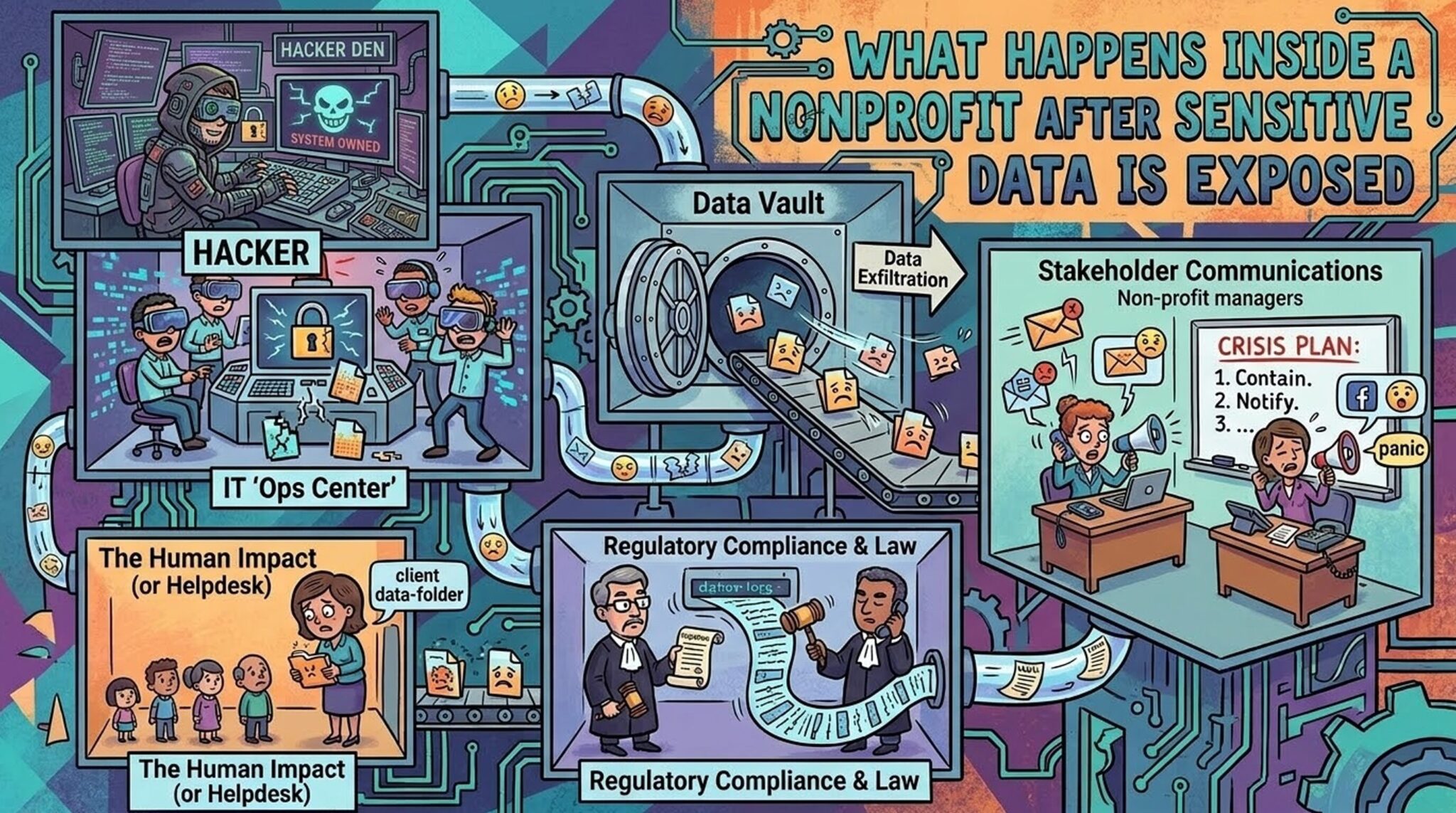
No alarms. No obvious system failure. Just a small anomaly, an unusual login, a flagged transaction, or a concerned donor asking about suspicious activity… But behind the scenes, a much larger crisis may already be unfolding. In this scenario-based guide, we walk through what actually happens inside a nonprofit after sensitive data is exposed, from the initial discovery to the long-term fallout.
Stage 1: The Moment of Exposure (Often Unnoticed)
In many cases, nonprofits don’t immediately realize data has been exposed.
The breach might begin with:
-
A compromised password
-
A phishing email clicked by a staff member
-
An insecure third-party integration
-
Misconfigured cloud storage
According to reporting from major news outlets, breaches often go undetected for extended periods, giving attackers time to extract sensitive data before anyone notices.
What’s happening internally:
-
Unauthorized access to donor databases
-
Silent data exfiltration
-
No immediate operational disruption
At this stage, organizations without our proactive monitoring tools may have no visibility into the breach at all.
Stage 2: Uncertainty & Investigation (What Happened?)
Eventually, something triggers concern:
-
A spike in failed logins
-
Reports of fraudulent transactions
-
Alerts from a payment processor
-
Suspicious system behavior
This is when uncertainty sets in.
Internal response:
-
Leadership is notified
-
IT teams begin investigating logs
-
Access may be temporarily restricted
But here’s the challenge: Most nonprofits lack the nonprofit IT consulting partner necessary to quickly determine:
-
When the breach started
-
What data was accessed
-
Whether the threat is still active
Research from cybersecurity reporting shows that identifying and containing breaches can take weeks or longer without proper systems in place.
Stage 3: Operational Disruption (Everything Slows Down)
As the investigation deepens, normal operations begin to break down.
Common disruptions include:
-
Fundraising campaigns paused
-
Donation platforms temporarily shut down
-
Staff locked out of systems
-
Event operations affected
In some cases, organizations must take systems offline entirely to prevent further damage.
Real-world impact:
-
Lost donations during downtime
-
Missed campaign deadlines
-
Reduced donor engagement
Coverage from global news sources highlights how operational shutdowns are often necessary to contain cyber incidents.
Stage 4: Financial & Compliance Consequences
Once the scope of the breach becomes clearer, the financial reality sets in.
Direct costs:
-
Incident response and forensic analysis
-
Legal and compliance expenses
-
System restoration and upgrades
Indirect costs:
-
Lost fundraising revenue
-
Donor churn
-
Reputational damage
If sensitive donor data is involved, nonprofits may also face:
-
Mandatory breach notifications
-
Regulatory scrutiny
-
Potential fines depending on jurisdiction
According to reporting on cybersecurity incidents, regulatory and legal costs can significantly exceed the initial technical response. Making an investment in data protection is a far better option than taking the damages that can be caused.
Stage 5: Rebuilding Trust With Donors
After containment, the hardest part begins: rebuilding trust. Donors expect transparency, but also competence.
Nonprofits must:
-
Notify affected individuals
-
Explain what happened
-
Outline steps taken to prevent future incidents
Even with a strong response, some donors may hesitate to give again.
Internal challenges:
-
Staff morale drops
-
Leadership faces pressure
-
Communications must be carefully managed
Stage 6: Long-Term Changes (Or Missed Opportunities)
After the crisis, nonprofits face a critical choice:
Option 1: Reactive recovery
-
Fix only what broke
-
Resume operations quickly
-
Delay broader improvements
Option 2: Strategic transformation
-
Implement stronger cybersecurity controls
-
Improve monitoring and response capabilities
-
Build long-term resilience
Unfortunately, many organizations fall into the first category: leaving them vulnerable to future incidents.